Category: Linguistics

Turing tests in Chinese rooms: What does it mean for AI to outperform humans

by Dominik Lukeš ·

TLDR; Reports that AI beat humans on certain benchmarks or very specialised tasks don’t mean that AI is actually better at those tasks than any individual human. They certainly don’t mean that AI is approaching the task with any of the same understanding of the world people do. People actually perform 100% on the tasks…

Read more →

Fruit loops and metaphors: Metaphors are not about explaining the abstract through concrete but about the dynamic process of negotiated sensemaking

by Dominik Lukeš ·

Note: This is a slightly edited version of a post that first appeared on Medium . It elaborates and exemplifies examples I gave in the more recent posts on metaphor and explanation and understanding . One of the less fortunate consequences of the popularity of the conceptual metaphor paradigm (which is also the one I…

Read more →

What would make linguistics a better science? Science as a metaphor

by Dominik Lukeš ·

Background This is a lightly edited version of a comment posted on Martin Haspelmath's blog post " Against traditional grammar – and for normal science in linguistics ". In it he offers a critique of the current linguistic scene as being unclear as to its goals and in need of better definitions. He proposes 'normal…

Read more →

3 burning issues in the study of metaphor

by Dominik Lukeš ·

I'm not sure how 'burning' these issues are as such but if they're not, I'd propose that they deserve to have some kindling or other accelerant thrown on them. 1. What is the interaction between automatic metaphor processing and deliberate metaphor application? Metaphors have always been an attractive subjects of study. But they have seen…

Read more →

Does machine learning produce mental representations?

by Dominik Lukeš ·

TL;DR Why is this important? Many people believe that mental representations are the next goal for ML and a prerequisite for AGI. Does machine learning produce mental representations equivalent to human ones in kind (if not in quality or quantity)? Definitely not, and there is no clear pathway from current approaches to a place where…

Read more →

Not ships in the night: Metaphor and simile as process

by Dominik Lukeš ·

In some circles (rhetoric and analytics philosophy come to mind), much is made of the difference between metaphor and simile. (Rhetoricians pay attention to it because they like taxonomies of communicative devices and analytic philosophers spend time on it because of their commitment to a truth-theoretical account of meaning and naive assumptions about compositionality). It…

Read more →

How to read ‘Women, Fire and Dangerous Things’: Guide to essential reading on human cognition

by Dominik Lukeš ·

Note: These are rough notes for a metaphor reading group, not a continuous narrative. Any comments, corrections or elaborations are welcome. Why should you read WFDT? Women, Fire, and Dangerous Things: What Categories Reveal About the Mind is still a significantly underappreciated and (despite its high citation count) not-enough-read book that has a lot to…

Read more →

Anthropologists' metaphorical shenanigans: Or how (not) to research metaphor

by Dominik Lukeš ·

Over on the excellent 'Genealogy of Religion' , Cris Campbell waved a friendly red rag in front of my eyes to make me incensed over exaggerated claims (some) anthropologists make about metaphors. I had expressed some doubts in previous comments but felt that perhaps this particular one deserves its own post. The book Cris refers…

Read more →

What does it mean when words 'really' mean something: Dismiss the Miss

by Dominik Lukeš ·

A few days ago, I tweeted a link to an article in TES : What Miss really means < It's always worthwhile re-examining ingrained inequalities http://t.co/GKhjc4VgUP #edchat #ukedchat #feminism — Dominik Lukes (@techczech) May 17, 2014 Today, I got the following response back: @techczech 'really means' talks about origins. It doesn't mean that to me…

Read more →

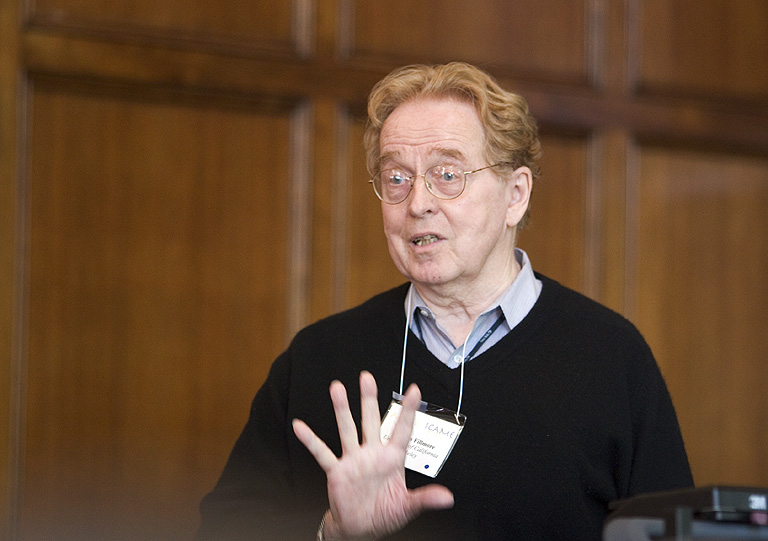
Linguistics according to Fillmore

by Dominik Lukeš ·

While people keep banging on about Chomsky as being the be all and end all of linguistics (I'm looking at you philosophers of language), there have been many linguists who have had a much more substantial impact on how we actually think about language in a way that matters. In my post on why Chomsky…

Read more →

Binders full of women with mighty pens: What is metonymy

by Dominik Lukeš ·

Metonymy in the wild Things were not going well for Mitt Romney in early autumn of last year. And then he responded to a query about gender equality with this sentence: "I had the chance to pull together a cabinet, and all the applicants seemed to be men… I went to a number of women's…

Read more →

Sunsets, horizons and the language/mind/culture distinction

by Dominik Lukeš ·

For some reason, many accomplished people, when they are done accomplishing what they've set out to accomplish, turn their minds to questions like: What is primary, thought or language. What is primary, culture or language. What is primary, thought or culture. I'd like to offer a small metaphor hack for solving or rather dissolving these…

Read more →

How we use metaphors

by Dominik Lukeš ·

I was reminded by this blog post on LousyLinguist that many people still see metaphor as an unproblematic homogeneous concept leading to much circular thinking about them. I wrote about that quite a few years ago in: Lukeš, D., 2005. Towards a classification of metaphor use in text: Issues in conceptual discourse analysis of a…

Read more →

Pseudo-education as a weapon: Beyond the ridiculous in linguistic prescriptivism

by Dominik Lukeš ·

[caption id="" align="alignright" width="300"] Teacher in primary school in northern Laos (Photo credit: Wikipedia)[/caption] Most of us are all too happy to repeat clichés about education to motivate ourselves and others to engage in this liminal ritual of mass socialization. One such phrase is "knowledge is power". It is used to refer not just to…

Read more →

The death of a memory: Missing metaphors of remembering and forgetting?

by Dominik Lukeš ·

I have forgotten a lot of things in my life. Names, faces, numbers, words, facts, events, quotes. Just like for anyone, forgetting is as much a part of my life as remembering. Memories short and long come and go. But only twice in my life have I seen a good memory die under suspicious circumstances…

Read more →

The brain is a bad metaphor for language

by Dominik Lukeš ·

Note: This was intended to be a brief note. Instead it developed into a monster post that took me two weeks of stolen moments to write. It's very light on non-blog references but they exist. Nevertheless, it is still easy to find a number of oversimplifications, conflations, and other imperfections below. The general thrust of…

Read more →

Literally: Triumph of pet peeve over matter

by Dominik Lukeš ·

I have a number of pet peeves about how people use language. I am genuinely annoyed by the use of apostrophes before plural of numerals or acronyms like 50's or ABC's. But because I understand how language works, I keep my mouth shut. The usage has obviously moved on. I don't think, ABC's is wrong…

Read more →

Why Chomsky doesn't count as a gifted linguist

by Dominik Lukeš ·

Somebody commented on the Language Log saying "of course [...] Chomsky was a massively gifted linguist" http://j.mp/9Q98Bx and for some reason, to use a Czech idiom, the handle of the jar repeatedly used to fetch water just fell off. Meaning, I've had enough. I think we should stop thinking of Chomsky as a gifted linguist…

Read more →