Category: Framing

Learning is a Journey: Consequences of a metaphor

by Dominik Lukeš ·

How to read this This will take about 18 minutes to read (at 230 words/min ) but the text is structured to make it easy to jump around and find the key points faster. I tend to go into more detail than most people find necessary. Two reasons to read : Explore a different perspective…

Read more →


Why I am a feminist: A reading list

by Dominik Lukeš ·

I became a feminist because a woman once told me not to be an idiot and I decided that it was good advice. That was in 1998. But I was all ready to be a feminist long before that, so it really just took a small push to get me over the hump. I was…

Read more →

Metaphors and freedom: On Tolkien's notion of allegory vs applicability

by Dominik Lukeš ·

On rereading Tolkien's Lord of the Rings, I was struck by this passage in his foreword to the second edition: I cordially dislike allegory in all its manifestations, and always have done so since I grew old and wary enough to detect its presence. I much prefer history, true or feigned, with its varied applicability…

Read more →

5 books on knowledge and expertise: Reading list for exploring the role of knowledge and deliberate practice in the development of expert performance

by Dominik Lukeš ·

Recently, I've been exploring the notion of explanation and understanding . I was (partly implicitly) relying on the notion of 'mental representations' as built through deliberate practice. My plan was to write next about how I think we can reconceptualize deliberate practice in such a way that it draws on a richer conception of 'mental…

Read more →

Does machine learning produce mental representations?

by Dominik Lukeš ·

TL;DR Why is this important? Many people believe that mental representations are the next goal for ML and a prerequisite for AGI. Does machine learning produce mental representations equivalent to human ones in kind (if not in quality or quantity)? Definitely not, and there is no clear pathway from current approaches to a place where…

Read more →

Not ships in the night: Metaphor and simile as process

by Dominik Lukeš ·

In some circles (rhetoric and analytics philosophy come to mind), much is made of the difference between metaphor and simile. (Rhetoricians pay attention to it because they like taxonomies of communicative devices and analytic philosophers spend time on it because of their commitment to a truth-theoretical account of meaning and naive assumptions about compositionality). It…

Read more →

How to read ‘Women, Fire and Dangerous Things’: Guide to essential reading on human cognition

by Dominik Lukeš ·

Note: These are rough notes for a metaphor reading group, not a continuous narrative. Any comments, corrections or elaborations are welcome. Why should you read WFDT? Women, Fire, and Dangerous Things: What Categories Reveal About the Mind is still a significantly underappreciated and (despite its high citation count) not-enough-read book that has a lot to…

Read more →

What does it mean when words 'really' mean something: Dismiss the Miss

by Dominik Lukeš ·

A few days ago, I tweeted a link to an article in TES : What Miss really means < It's always worthwhile re-examining ingrained inequalities http://t.co/GKhjc4VgUP #edchat #ukedchat #feminism — Dominik Lukes (@techczech) May 17, 2014 Today, I got the following response back: @techczech 'really means' talks about origins. It doesn't mean that to me…

Read more →

What is not a metaphor: Modelling the world through language, thought, science, or action

by Dominik Lukeš ·

The role of metaphor in science debate (Background) Recently, the LSE podcast an interesting panel on the subject of "Metaphors and Science" . It featured three speakers talking about the interface between metaphor and various 'scientific' disciplines (economics, physics and surgery). Unlike many such occasions, all speakers were actually very knowledgeable and thoughtful on the…

Read more →

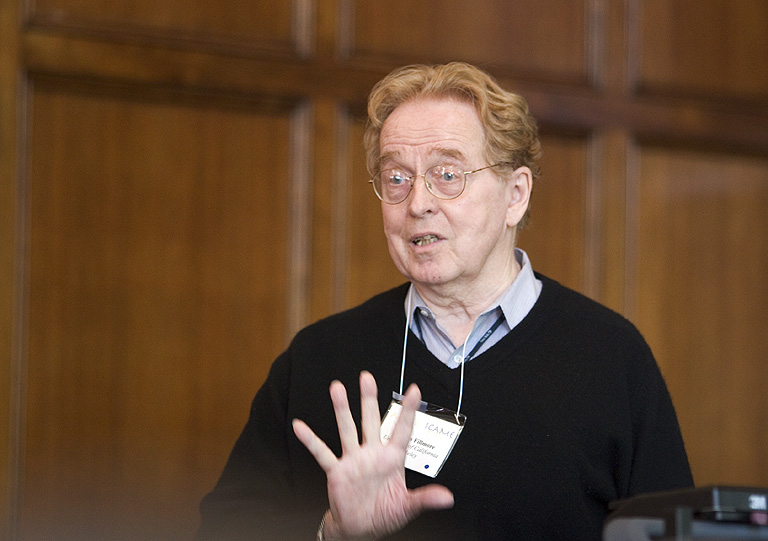
Linguistics according to Fillmore

by Dominik Lukeš ·

While people keep banging on about Chomsky as being the be all and end all of linguistics (I'm looking at you philosophers of language), there have been many linguists who have had a much more substantial impact on how we actually think about language in a way that matters. In my post on why Chomsky…

Read more →

Binders full of women with mighty pens: What is metonymy

by Dominik Lukeš ·

Metonymy in the wild Things were not going well for Mitt Romney in early autumn of last year. And then he responded to a query about gender equality with this sentence: "I had the chance to pull together a cabinet, and all the applicants seemed to be men… I went to a number of women's…

Read more →

Pervasiveness of Obliging Metaphors in Thought and Deed

by Dominik Lukeš ·

" when history is at its most obliging, the history-writer needs be at his most wary." ( China by John Keay ) I came across this nugget of wisdom when I was re-reading the Introduction to John Keay's history of China. And it struck me that in some way this quote could be a part…

Read more →

Cliches, information and metaphors: Overcoming prejudice with metahor hacking and getting it back again

by Dominik Lukeš ·

[caption id="" align="alignright" width="240"] Professor Abhijit Banerjee (Photo credit: kalyan3)[/caption] "We have to use cliches," said professor Abhijit Banerjee at the start of his LSE lecture on Poor Economics . "The world is just too complicated." He continued. "Which is why it is all the more important, we choose the right cliches." [I'm paraphrasing here.]…

Read more →

21st Century Educational Voodoo

by Dominik Lukeš ·

Jim Shimabukuro uses Rupert Murdoch's quote “We have a 21st century economy with a 19th century education system” to pose a question of what should 21st Century Education look like ( http://etcjournal.com/2008/11/03/174/ ) "what are the key elements for an effective 21st century model for schools and colleges?". However, what he is essentially asking us…

Read more →

Moral Compass Metaphor Points to Surprising Places

by Dominik Lukeš ·

I thought the moral compass metaphor has mostly left current political discourse but it just cropped up - this time pointing from left to right - as David Plouffe accused Mitt Romney of not having one . As I keep repeating, George Lakoff once said “Metaphors can kill.” And Moral Compass has certainly done its…

Read more →

Poetry without metaphor? Sure but can it darn your socks?

by Dominik Lukeš ·

Over on the Language Log , Victor Mair puts to rest that all English expressions have to be tensed and thus prevent timeless poetry. He shares his translation of a 13th century Chinese poet thus: Autumn Thoughts by Ma Zhiyuan Withered wisteria, old tree, darkling crows – Little bridge over flowing water by someone's house…

Read more →

Do science fiction writers dream of fascist dictatorships?

by Dominik Lukeš ·

Some years ago in a book review , I made an off-the-cuff comment that thriller writers tend to be quite right-wing in their outlook whereas science fiction authors are much more progressive and leftist. This is obviously an undue generalisation (as most of such comments tend to be) but it felt intuitively right. Even then…

Read more →

The most ridiculous metaphor of education courtesy of an economics professor

by Dominik Lukeš ·

Acclaimed academics have policy agendas just like anybody else. And often they let them interfere with a straightforward critical analysis of their output. The monumental capacity for blindness of highly intelligent people is sometimes staggering. Metaphors and analogies (same thing for metaphor hacking) make thinkers particularly prone to mis-projection blindness . Edward Glaeser , a…

Read more →

The Tortoise and the Hare: Analogy for Academia in the Digital World?

by Dominik Lukeš ·

Dan Cohen has decided to "crowdsource" (a fascinating blend, by the way) the title of his next book with the following instructions. The title should be a couplet like “The X and the Y” where X can be “Highbrow Humanities” “Elite Academia” “The Ivory Tower” “Deep/High Thought” [insert your idea] and Y can be “Lowbrow…

Read more →